
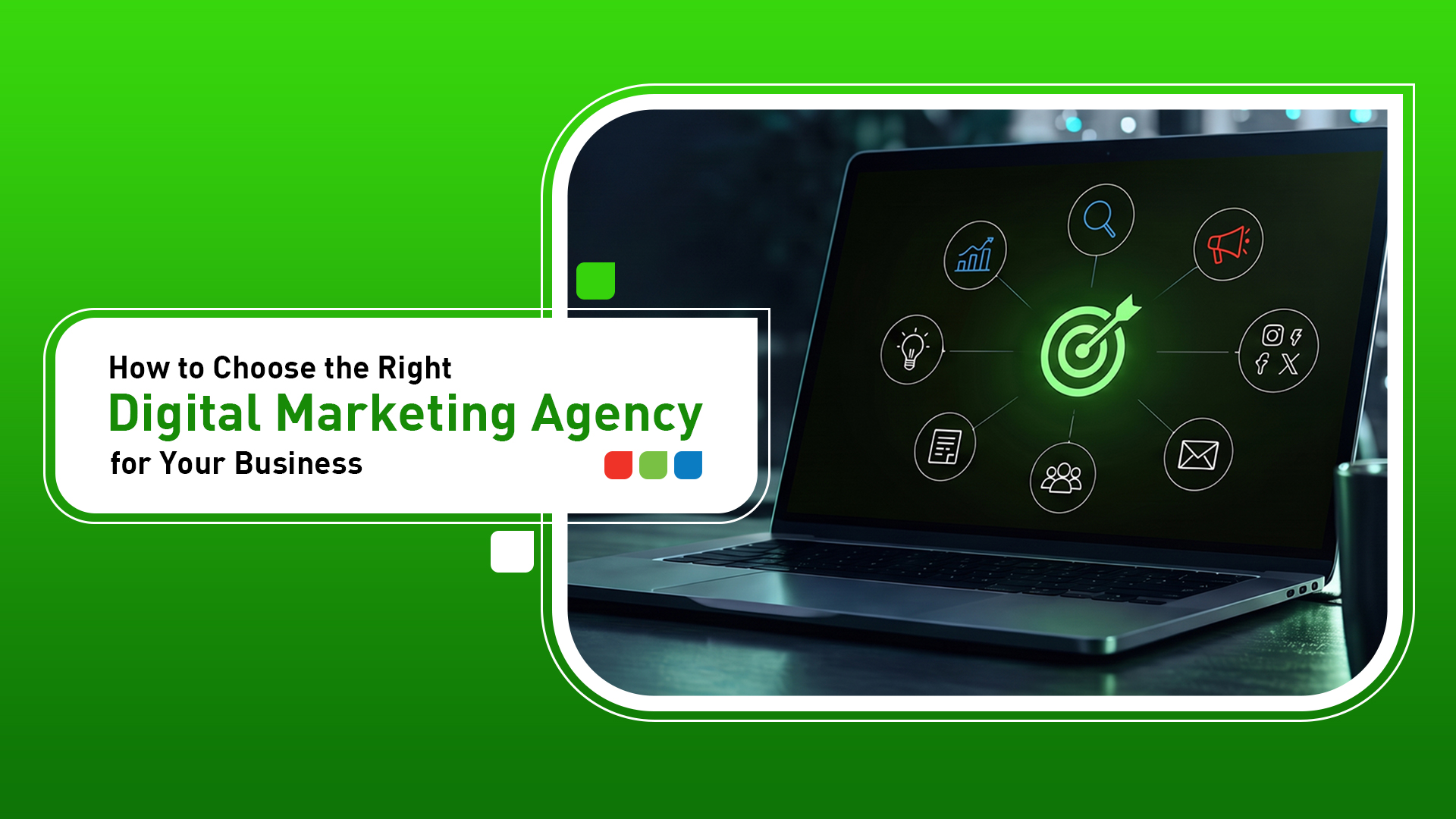
How to Choose the Right Digital Marketing Agency for Your Business
Choosing a digital marketing agency is an important business decision. The right partner can help you generate qualified leads, increase sales, improve search visibility and build a stronger online presence. The wrong fit can leave you spending money without a clear understanding of what is actually working.
The key is to look beyond impressive presentations, promises and follower counts. A good agency should understand your business goals, identify the right marketing channels, explain its strategy clearly, measure meaningful outcomes and communicate what is working—and what needs to change.
Quick Answer: What Should You Look for in a Digital Marketing Agency?
The right digital marketing agency should match your business goals, target audience, industry, budget and marketing requirements. Before hiring an agency, evaluate its relevant experience, case studies, services, reporting process, team structure, pricing, contract terms and ownership of your advertising accounts and marketing assets.
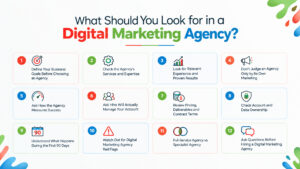
Most importantly, don’t choose an agency simply because it is the cheapest or has the biggest portfolio. Choose based on whether its approach fits your business and whether it can clearly explain how its work will contribute to your objectives.
1. Define Your Business Goals Before Choosing an Agency
Before searching for a digital marketing agency, define what you actually want to achieve.
“Improve my digital marketing” is too broad to build an effective strategy around.
Instead, identify specific business objectives.
Do You Want More Leads?
If your primary goal is lead generation, your agency should understand:
(i) Lead generation campaigns
(ii)Google Ads
(iii) Meta Ads
(iv) Landing page optimization
(v) Conversion tracking
(vi) Lead qualification
(vii) Cost per lead
(viii) Conversion rates
The objective isn’t simply to generate more form submissions. It is to generate leads that have a realistic chance of becoming customers.
Do You Want More Sales?
E-commerce businesses and sales-driven companies may need a combination of:
(i) Paid search
(ii)Shopping campaigns
(iii) Meta advertising
(iv) SEO
(v) Remarketing
(vi) Conversion rate optimization
(vii) Product-focused content
Your agency should understand the complete customer journey rather than treating every channel separately.
Do You Want Better Brand Visibility?
If your priority is brand awareness, your strategy may involve:
(i) Social media marketing
(ii) Video marketing
(ii) Content marketing
(iv) Influencer marketing
(v) SEO
(vi) Paid social
(vii) Creative campaigns
(viii) Brand positioning
The right mix depends on your audience and business model.
Do You Want More Organic Traffic?
For businesses looking for sustainable search visibility, SEO may include:
(i) Keyword research
(ii) Technical SEO
(iii) On-page SEO
(iv) Content strategy
(v) Internal linking
(vi) Off-page SEO
(vii) Digital PR
(viii) Conversion optimization
A strong SEO strategy should focus on attracting relevant users, not simply increasing the number of visitors.
2. Check the Agency’s Services and Expertise
Once you know your goals, evaluate whether an agency actually provides the services you need.
A modern digital marketing strategy can involve several channels.
SEO
SEO helps businesses improve their visibility in organic search results.
Look for an agency that understands:
(i) Technical SEO
(ii) Keyword research
(iii) Search intent
(iv) On-page optimization
(v) Content strategy
(vi) Internal linking
(vii) Off-page SEO
(viii) SEO measurement
inkSPILLED, for example, provides SEO services covering SEO audits, custom SEO strategy, on-page SEO, off-page SEO and backlink building.
Google Ads and Paid Media
Paid search can help businesses reach people who are actively searching for relevant products or services.
An agency managing paid media should understand:
(i) Keyword targeting
(ii) Search campaigns
(iii) Ad copy
(iv) Landing pages
(v) Conversion tracking
(vi) Bid strategies
(vii) Cost per lead
(vii) Performance optimization
inkSPILLED’s paid media offering includes SEM/SEA, social media advertising, YouTube advertising, performance marketing and influencer marketing.
Social Media Marketing
Social media isn’t only about posting regularly.
A professional social media strategy can include:
(i) Audience research
(ii) Content planning
(iii) Creative development
(iv) Community engagement
(v) Organic social campaigns
(vi) Paid social campaigns
(vii) Analytics
(viii) A/B testing
inkSPILLED’s social media service covers social media optimization, social media marketing, analytics, organic campaigns and social media advertising.
3. Look for Relevant Experience and Proven Results
An agency may have an impressive portfolio, but the more important question is:
Has it worked on problems similar to yours?
For example, an e-commerce company may need a very different marketing approach from a B2B consulting company.
Ask the agency for relevant examples.
What Makes a Good Case Study?
A useful case study should explain:
(i) The client’s starting position
(ii) The business challenge
(iii) The marketing strategy
(iv) Channels used
(v) Work completed
(vi) Time period
(vi) Key results
(vii) Measurement method
Be cautious of vague claims such as “we transformed their online presence.”
Ask for measurable outcomes where the client permits disclosure.
For example: Organic leads increased from X to Y over a defined period. or Cost per qualified lead decreased after campaign optimization.
The exact metrics will vary by business.
4. Don’t Judge an Agency Only by Its Own Marketing
An agency’s own website can tell you something about its capabilities, but it shouldn’t be your only evaluation method.
Check:
(i) Website quality
(ii) Organic visibility
(iii) Content quality
(iv) Social presence
(v) Case studies
(vi) Reviews
(vii) Team experience
(viii) Communication
(ix) Strategy
(x) Reporting
Also remember that an agency may specialize in paid acquisition while another specializes in SEO or creative branding. Their own marketing performance should therefore be considered alongside the service you are actually buying.
5. Ask How the Agency Measures Success
This is one of the most important questions to ask.
A marketing report can contain hundreds of numbers.
But not every number matters to your business.
Important Marketing Metrics
Depending on your business model, you may want to track:
(i) Website traffic
(ii) Qualified leads
(iii) Cost per lead
(iv) Conversion rate
(v) Customer acquisition cost
(vi) Sales
(vii) Revenue
(viii) Return on ad spend
(ix) Organic visibility
(x) Search rankings
(xi) Engagement
(xii) Landing page performance
For example, 100,000 website visitors may sound impressive.
But if those visitors don’t match your target audience and generate no enquiries, the traffic may have limited commercial value.
A good agency should connect marketing activity to business objectives as closely as your tracking setup allows.
6. Ask Who Will Actually Manage Your Account
During the sales process, you may speak with a senior strategist or business development executive.
But who will manage your campaigns after you sign?
Ask:
(i) Who is my account manager?
(ii) Who manages SEO?
(iii) Who creates and manages advertising campaigns?
(iv) Who creates content?
(v) Who designs creatives?
(vi) Who analyzes performance?
(vii) How often will we communicate?
(viii) Who makes strategic decisions?
You should understand the actual delivery team before signing a contract.
7. Review Pricing, Deliverables and Contract Terms
Digital marketing agency pricing varies considerably depending on the services, scope, market, team and complexity of the campaign.
Don’t compare agencies only on their monthly fee.
Compare what you actually receive.
Ask for a Clear Scope of Work
Your proposal should ideally explain:
(i) Services included
(ii) Number of campaigns
(iii) Content deliverables
(iv) Creative deliverables
(v) SEO activities
(vi) Reporting frequency
(vii) Meetings
(viii) Optimization process
(ix) Communication channels
(x) Additional charges
A low-cost proposal with very limited deliverables may not be cheaper in practice.
Similarly, a higher-priced agency should be able to explain what additional expertise, resources or strategic depth you are receiving.
8. Check Account and Data Ownership
This is an important point that businesses sometimes overlook.
Before signing, clarify who owns:
(i) Google Ads accounts
(ii) Meta Business accounts
(iii) Website
(iv) Domain
(v) Analytics accounts
(vi) Search Console
(vii) Creative assets
(viii) Marketing data
(ix) Customer data
(x) Content
Ideally, your business should maintain appropriate ownership and administrative access to its core digital assets.
This makes changing agencies, bringing work in-house or adding another partner much easier.
9. Understand What Happens During the First 90 Days
Don’t expect every marketing channel to produce the same results at the same speed.
The first few months are often used to understand the business, implement tracking, establish a strategy, launch campaigns and collect performance data.
First 30 Days
A typical onboarding process may include:
(i) Business discovery
(ii) Competitor research
(iii) Audience research
(iv) Account audits
(v) Analytics review
(vi) Tracking setup
(vii) Keyword research
(viii) Campaign planning
(ix) Content planning
Days 31–60
The focus may shift toward:
(i) Campaign launches
(ii) SEO implementation
(iii) Content production
(iv) Creative testing
(v) Landing page optimization
(vi) Audience testing
(vii) Performance analysis
Days 61–90
The agency should increasingly use campaign data to:
(i) Identify what is working
(ii) Identify underperforming activities
(iii) Optimize campaigns
(iv) Improve conversion rates
(v) Refine targeting
(vi) Adjust budgets
(vii) Build the next phase of the strategy
The exact timeline will differ by business and channel.
10. Watch Out for Digital Marketing Agency Red Flags
Before signing a contract, look carefully at how an agency communicates its promises.
Guaranteed Google Rankings
SEO involves many variables outside an agency’s direct control. Be cautious about absolute ranking guarantees.
Guaranteed Number of Leads
Lead volume depends on factors such as market demand, budget, offer, audience, competition, website experience and conversion rates.
No Clear Reporting
If an agency cannot explain what it will measure and how often it will report, ask for more detail before signing.
No Relevant Case Studies
A large logo portfolio isn’t necessarily evidence of relevant expertise.
Ask for examples that resemble your business model, target audience or marketing challenge.
Unclear Deliverables
“Complete digital marketing” is not a sufficient scope of work.
Ask exactly what will be done each month.
No Account Access
You should understand how access and ownership of your marketing accounts will work before the relationship begins.
Too Much Focus on Vanity Metrics
Followers, impressions and clicks can be useful indicators, but they should be considered alongside meaningful business outcomes.
Full-Service Agency vs Specialist Agency
Another important question is whether you need a full-service digital marketing agency or a specialist.
A Specialist Agency May Make Sense When:
You have one specific requirement, such as:
(i) Technical SEO
(ii) Google Ads
(iii) Meta Ads
(iv) Website development
(v) Social media
(vi) Video production
A Full-Service Agency May Make Sense When:
You want multiple channels managed as part of one strategy.
For example:
SEO + Google Ads + Social Media + Creative + Website + Content
The important consideration is not whether one model is universally better. It is whether the agency’s capabilities match the complexity of your marketing requirements.
12. Ask These Questions Before Hiring a Digital Marketing Agency
Before signing, ask the following:
1. What experience do you have in my industry?
2. Can you show relevant case studies?
3. What will your strategy be for my business?
4. Which channels do you recommend and why?
5. Who will manage my account?
6. What KPIs will you track?
7. How frequently will I receive reports?
8. How do you measure qualified leads?
9. What does the monthly scope include?
10. Are there additional costs?
11. Who owns the advertising accounts?
12. Who owns the website and creative assets?
13. What happens if a campaign underperforms?
14. How often will we review the strategy?
15. What should I realistically expect during the first 90 days?
The quality of an agency’s answers can tell you a lot about how it approaches client relationships.
Frequently Asked Questions
How do I choose the right digital marketing agency?
Start by defining your business goals and then evaluate an agency’s relevant experience, services, case studies, reporting, team, pricing, contract terms and account ownership.
What should I look for in a digital marketing agency?
Look for relevant expertise, a clear strategy, measurable case studies, transparent reporting, clear deliverables and a team that understands your business objectives.
How much does a digital marketing agency cost?
There is no single standard price. Cost depends on the services, campaign complexity, market, business goals, advertising budget and amount of work required.
How long does digital marketing take to produce results?
It depends on the channel and business. Paid campaigns can generate data quickly, while SEO and content marketing generally require more time to build organic visibility. Your agency should set channel-specific expectations rather than promising one universal timeline.
Should I hire an SEO agency or a Google Ads agency?
That depends on your objectives. SEO focuses on organic search visibility, while Google Ads provides paid visibility in search and other Google advertising environments. Some businesses benefit from using both.
What questions should I ask before hiring a marketing agency?
Ask about relevant experience, strategy, case studies, KPIs, reporting, team structure, pricing, contract terms, account ownership and expected milestones.
Who should own my Google Ads and Meta Ads accounts?
Businesses should carefully clarify account ownership and administrative access before signing an agency agreement. Maintaining appropriate access to core marketing assets can make future transitions easier.
How do I know whether my marketing agency is delivering results?
Look beyond impressions and clicks. Depending on your business, evaluate qualified leads, conversion rates, cost per acquisition, sales, revenue, organic growth and other agreed KPIs.
Final Thoughts
Choosing the right digital marketing agency isn’t about finding the agency with the biggest portfolio or the lowest price.
It is about finding a partner whose strategy, expertise, services, communication and measurement approach fit your business goals.
Before signing, ask for evidence. Understand the scope. Clarify the KPIs. Review the contract. Confirm account ownership. And make sure you know who will actually be responsible for your marketing.
For businesses looking for a combination of SEO, paid media, social media marketing, creative and digital strategy, inkSPILLED offers multiple marketing capabilities under one agency. You can explore the different services and identify the areas most relevant to your growth objectives.
Explore inkSPILLED’s Digital Marketing Services
If you are evaluating agencies, the best starting point is to clearly define the business problem you want marketing to solve. Once that is clear, it becomes much easier to compare agencies based on strategy and fit rather than simply comparing monthly fees.
Related Post
-
 25 Jul, 24
InkSpilled -Best digital marketing agency in Delhi
Delhi, a city pulsating with energy and innovation, is a hotbed for businesses looking to make their mark. To truly stand out in this competitive landscape, a robust digital presence is paramount. This is where InkSpilled, the best digital marketing company in Delhi, steps in. Our mission is simple:
-
 14 May, 24
Why the Best Digital Marketing Agency Do AI-led Marketing
Why the best digital marketing agencies in India are choosing AI-led marketing? So that they can come under the ‘best’ category & businesses would prefer them over others who aren’t AI specific. The clever marketing agencies understand that AI is not just a buzzword.
-
 24 Jul, 24
Website Designing Services India: InkSpilled – Your Brand’s Digital Architect
In today's digital age, a website is more than just an online brochure; it's the face of your brand. A well-designed website can leave a lasting impression, engage your target audience, and drive conversions. That's where InkSpilled, the best digital marketing