
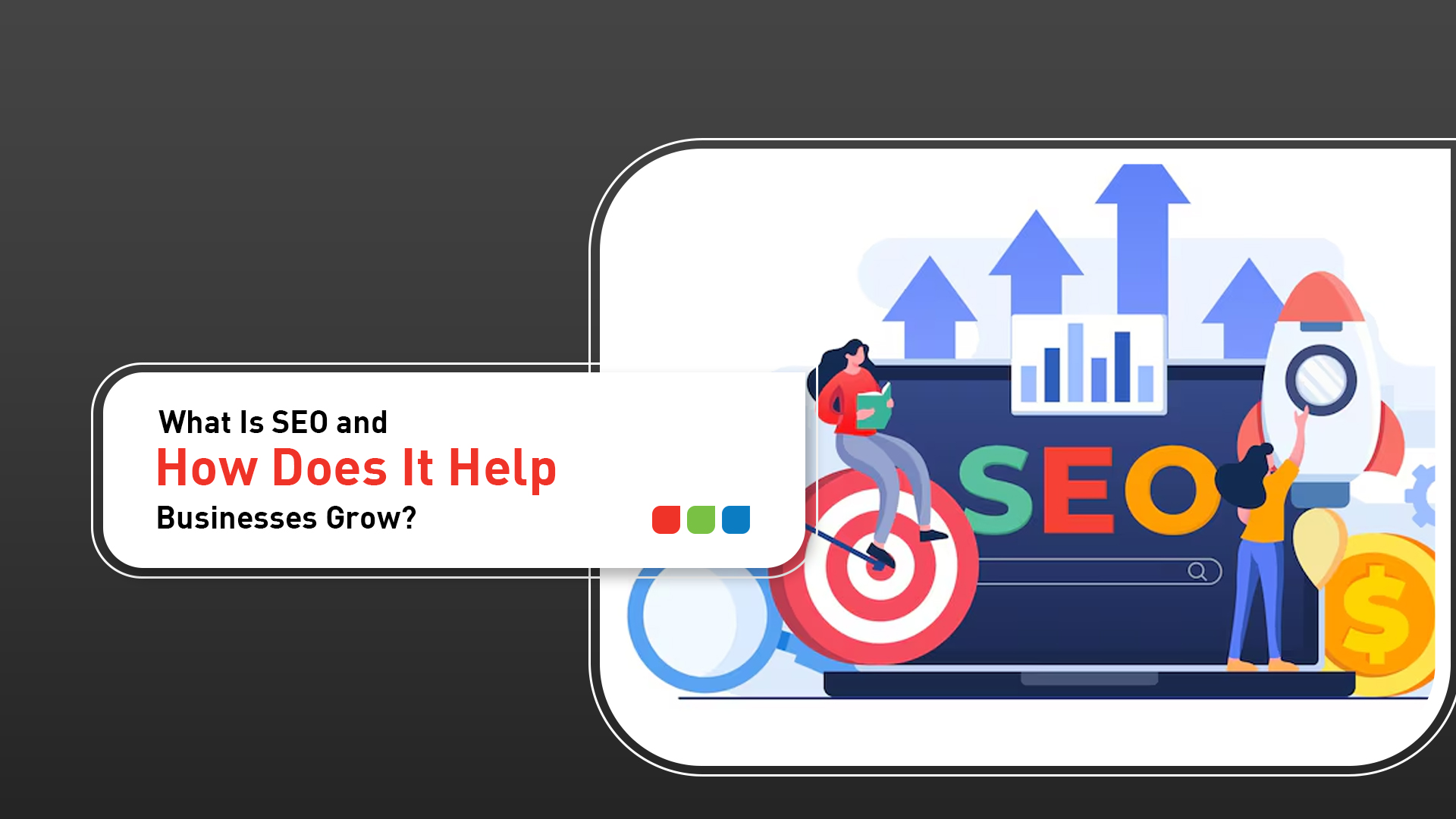
What Is SEO and How Does It Help Businesses Grow?
In today’s digital world, having a website is not enough to attract customers. Your potential customers must be able to find your business when they search online for products, services, and solutions. This is where Search Engine Optimization (SEO) becomes important.
SEO helps businesses improve their visibility in organic search results, attract relevant website visitors, build credibility, and create more opportunities for leads and sales.
Whether you run a small business, a startup, an e-commerce store, or an established company, a well-planned SEO strategy can help you reach people who are already searching for what you offer.
For example, if someone searches for a digital marketing agency in India, a business with relevant content, useful service pages, and a technically sound website has an opportunity to appear in search results and attract that potential customer.
In this guide, we will explain what SEO is, how it works, why it matters for business growth, and how you can use it to improve your online presence.
What Is SEO?
SEO, or Search Engine Optimization, is the process of improving a website to help search engines understand its content and make its pages more visible in relevant organic search results.
It involves optimizing website content, improving technical performance, researching keywords, building website authority, and providing a helpful experience for visitors.
Unlike paid advertising, organic SEO does not involve paying for every click from a search result. However, SEO requires investment in content, expertise, tools, and ongoing optimization.
The primary goal of SEO is not simply to rank higher on Google. It is to connect your business with the right audience at the right moment and turn relevant website visits into meaningful business results.
How Does Search Engine Optimization Work?
Search engines use automated systems to discover, understand, index, and rank web pages. SEO helps improve the likelihood that your website can be discovered and considered relevant for searches related to your business.
(i) Crawling: Search engines discover pages through links, sitemaps, and other methods.
(ii) Indexing: Search engines analyze eligible pages and may store information about them in their index.
(iii)Ranking: When someone searches, search engines select and order results based on relevance, quality, and many other signals.
Good SEO makes pages easier to discover and understand while ensuring the content addresses what users are looking for. Indexing and rankings are never guaranteed.
What Are the Main Types of SEO?
On-Page SEO
On-page SEO involves optimizing individual website pages through relevant headings, useful content, title tags, meta descriptions, internal links, image descriptions, and clear page structure. For example, a digital marketing agency can create a dedicated page explaining its SEO services, the problems it solves, and how potential clients can get started.
Technical SEO
Technical SEO focuses on helping search engines access, crawl, and understand a website. Important areas include mobile-friendly design, responsive performance, logical website architecture, crawlability and indexability, HTTPS, XML sitemaps, and appropriate canonical tags.
Off-Page SEO
Off-page SEO involves activities outside your website that can support your reputation and authority. Examples include earning links from relevant, trustworthy websites, receiving legitimate industry mentions, and developing a recognizable brand.
Local SEO
Local SEO helps businesses become more visible in location-related searches. Optimizing a Google Business Profile, maintaining accurate business information, collecting genuine customer reviews, and creating useful local landing pages can support local visibility.
Why Is SEO Important for Businesses?
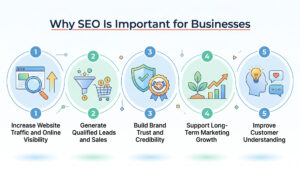
1. Increase Website Traffic and Online Visibility
Your potential customers may already be searching Google for the products or services you offer. SEO helps your website compete for visibility in those searches. For instance, a company offering website development may target searches related to business website design, e-commerce development, or website redesign services.
By creating useful pages that match those searches, the business can attract visitors with a genuine interest in its services. Focus on relevant traffic rather than traffic volume alone: a smaller number of highly interested visitors may produce more enquiries than a large audience with little purchase intent.
2. Generate Qualified Leads and Sales
SEO can help businesses reach people who are actively researching solutions or preparing to make a purchase. Someone searching for “SEO agency for small business” may be closer to hiring an agency than someone searching for a general definition of digital marketing.
Businesses can attract potential customers with service pages, comparison guides, case studies, pricing explanations, and informative articles. To convert visitors into leads, include clear service descriptions, relevant testimonials, easy-to-find contact information, strong calls to action, simple enquiry forms, and clear next steps.
SEO brings opportunities to your website, while conversion optimization helps turn those opportunities into business enquiries and sales.
3. Build Brand Trust and Credibility
People often discover businesses while researching a problem, comparing providers, or learning about a product. Publishing useful content and maintaining accurate, professional website pages can help establish credibility.
A marketing agency that explains SEO strategies, shares practical guidance, and demonstrates its expertise can give prospective customers more reasons to consider its services. Trust also depends on genuine reviews, transparent communication, accurate claims, and a good customer experience.
4. Support Long-Term Marketing Growth
Paid advertising can generate traffic while campaigns are active. SEO can build an organic presence that continues attracting visitors after individual pages begin ranking. This does not mean SEO traffic is permanent or free: rankings can change, competitors can improve, and content needs maintenance.
A collection of high-quality service pages and useful articles can become a valuable long-term marketing asset.
5. Improve Customer Understanding
Keyword research reveals the language people use when looking for information, products, and services. Search queries can help a business understand what customers want to know before buying, which problems they are trying to solve, what objections prevent enquiries, and what information is missing from competing websites.
These insights can guide SEO, paid advertising, social media content, landing pages, and sales conversations.
How Does SEO Help Different Types of Businesses?
SEO for Small Businesses and Startups
Small businesses often have limited marketing budgets and need to prioritize their efforts. A practical starting point is to optimize the homepage, create dedicated pages for important services, target relevant local and industry-specific keywords, and publish content that answers common customer questions.
A new business does not need to compete for every broad keyword immediately. It can begin with focused, high-intent searches that match its actual products, services, and service area.
SEO for E-commerce Businesses
E-commerce SEO helps shoppers discover product pages, category pages, and buying guides through organic search. Important activities include writing unique product descriptions, optimizing category structures, managing duplicate URLs, adding useful product information, and improving the mobile shopping experience.
Businesses should monitor whether organic visitors add products to their carts and complete purchases, rather than measuring success through rankings alone.
SEO for Local Businesses
Local SEO can help businesses connect with customers searching for nearby products and services. Accurate business listings, location-specific service pages, genuine customer reviews, and useful information about the areas served can support local visibility.
Avoid creating repetitive location pages with little unique value. Each location page should offer meaningful information relevant to its audience.
How Does SEO Work? A Step-by-Step Process
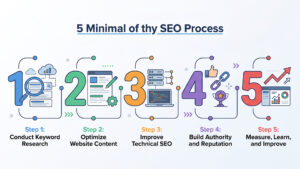
Step 1: Conduct Keyword Research
Identify the words and phrases potential customers use to find your products or services. Consider search intent, relevance, competition, and the likelihood that a search will lead to a business outcome. Separate informational searches from commercial and transactional searches so each page serves a clear purpose.
Step 2: Optimize Website Content
Create helpful landing pages and articles that answer real customer questions. Use descriptive headings, relevant terminology, logical internal links, and clear calls to action. Avoid keyword stuffing and pages created solely to manipulate rankings.
Step 3: Improve Technical SEO
Check whether important pages can be crawled and indexed. Review mobile usability, page speed, broken links, redirects, duplicate content, and website structure. Fix issues according to their impact on search accessibility and user experience.
Step 4: Build Authority and Reputation
Earn relevant backlinks through original research, useful resources, industry relationships, and genuinely valuable content. Prioritize quality and relevance rather than buying large volumes of low-quality links.
Step 5: Measure, Learn, and Improve
Use Google Search Console to review search impressions, clicks, queries, and page performance. Use analytics and CRM data to understand enquiries, purchases, and lead quality. Update your strategy based on actual results rather than rankings alone.
Neither approach is universally better. A business that needs immediate enquiries may use Google Ads while building its organic presence. SEO can gradually expand the number of searches through which the business attracts visitors without paying for every organic click.
Combining both channels can also provide useful insights into search demand, customer intent, and effective messaging. Businesses can explore InkSpilled’s digital marketing website at https://inkspilled.in/ to learn more about its marketing services.
How Long Does SEO Take to Show Results?
SEO does not have a fixed timeline. Results depend on factors such as website history, competition, content quality, technical issues, search demand, and the resources available for implementation. Some improvements, such as fixing crawlability problems or optimizing existing pages, may produce observable changes sooner. Building authority and gaining consistent rankings for competitive keywords can take considerably longer.
Businesses should establish realistic expectations and monitor progress over time. Useful milestones include resolving important technical issues, improving organic visibility for target searches, increasing relevant non-branded traffic, generating more qualified enquiries, improving conversion rates, and tracking revenue influenced by organic search.
Google Search Console can help you understand search visibility and clicks, while Google Analytics and your CRM can provide insight into visitor behavior and business outcomes.
For example, a service business may find that one article attracts substantial traffic but generates few enquiries, while a service page attracts fewer visitors who are more likely to become customers. That insight can help improve calls to action, internal links, landing pages, and content targeting.
Common SEO Mistakes Businesses Should Avoid
(i) Keyword stuffing: Repeating the same phrase unnaturally can make content difficult to read and does not guarantee better rankings.
(ii) Publishing thin or repetitive content: Pages should offer genuine value instead of repeating information already available elsewhere.
(iii) Ignoring technical problems: Important content may struggle to perform if pages cannot be accessed, crawled, or indexed properly.
(iv) Focusing only on rankings: High positions are not enough if the searches are irrelevant or visitors do not convert.
(v) Neglecting mobile users: A poor mobile experience can make it harder for potential customers to navigate the website or submit an enquiry.
(vi) Buying low-quality backlinks: Manipulative link schemes can create risks instead of building sustainable authority.
(vii) Expecting instant results: SEO requires testing, maintenance, and patience, particularly in competitive markets.
(viii) Failing to measure leads and sales: Businesses should connect search activity with meaningful outcomes wherever practical.
Does SEO Still Matter in the Age of AI Search?
Yes. SEO remains important as people discover information through traditional search results, AI-powered search experiences, and conversational tools. AI search systems may summarize information from multiple sources, so businesses should focus on creating content that is useful, accurate, clear, and easy to understand.
(i) Answer important customer questions directly.
(ii) Demonstrate real experience and subject expertise.
(iii) Support factual claims with reliable sources when appropriate.
(iv) Maintain accessible, well-structured website pages.
(v) Use descriptive headings and clear explanations.
(vi) Keep business information accurate and consistent.
(vii) Develop original insights, examples, and resources.
(viii) Review content regularly for outdated information.
There is no guaranteed formula for appearing in AI-generated answers. However, content that genuinely helps people and communicates information clearly gives search systems a better basis for understanding the business and its expertise.
SEO, answer-focused content, and generative search optimization should support the same goal: helping the right audience discover useful information about your business.
How Can Your Business Get Started With SEO?
1. Audit your website: Identify technical problems, weak landing pages, missing information, and opportunities to improve existing content.
2. Understand your customers: Research their needs, questions, search terms, and buying decisions.
3. Prioritize high-value pages: Improve the homepage and your most important service or product pages first.
4. Publish useful content: Create articles that answer relevant questions and naturally guide readers toward your services.
5. Improve conversion paths: Make contact details, enquiry forms, and calls to action easy to find.
6. Track performance: Monitor organic visibility, qualified leads, conversions, and revenue where measurable.
7. Refine the strategy: Use performance data to decide what to improve, expand, or discontinue.
Businesses with limited internal resources may benefit from working with an experienced digital marketing team that can coordinate technical SEO, content, paid advertising, and conversion optimization.
At InkSpilled, businesses can explore digital marketing solutions spanning search engine optimization, paid media, social media marketing, and other services designed to strengthen their online presence.
The right strategy will depend on your goals, industry, competition, and budget. Start with the opportunities most likely to help your business attract relevant customers and grow sustainably.
Frequently Asked Questions About SEO
What is SEO in simple words?
SEO is the process of improving a website so that search engines can better understand its content and users can discover it through relevant organic search results.
How does SEO help businesses grow?
SEO helps businesses improve online visibility, attract relevant visitors, establish credibility, and create opportunities for leads and sales. Its impact depends on how well the website meets customer needs and converts visitors.
Why is SEO important for small businesses?
SEO can help small businesses reach customers searching for relevant products or services without paying for every organic click. Local and niche-focused SEO can be particularly useful when resources are limited.
How long does SEO take to show results?
SEO timelines vary. Some changes may be noticed relatively quickly, while meaningful improvements in competitive search results can take months or longer. Results depend on competition, website quality, implementation, and other factors.
Is SEO better than Google Ads?
Neither is always better. SEO supports organic visibility over time, while Google Ads can deliver paid search exposure once campaigns are approved and running. The right choice depends on budget, goals, urgency, and competition.
How much does SEO cost?
SEO costs depend on the website’s condition, competition, business objectives, scope of work, and whether the work is handled internally or by an agency. Compare deliverables, expertise, reporting, and expected outcomes rather than price alone.
Can SEO generate leads and sales?
Yes. SEO can attract people searching for relevant services or products. Clear landing pages, strong offers, trustworthy information, and effective conversion paths help turn traffic into enquiries and sales.
What are the four main types of SEO?
Four commonly discussed categories are on-page SEO, technical SEO, off-page SEO, and local SEO. These areas overlap and work together to support a website’s search visibility.
Can a business do SEO without hiring an agency?
Yes. Businesses can begin with keyword research, useful content, basic technical checks, Google Search Console, and local listing optimization. More complex websites or competitive industries may require additional expertise and resources.
How do you measure SEO performance?
Measure organic clicks, impressions, relevant keyword performance, conversions, qualified leads, and revenue where attribution is available. Google Search Console, analytics platforms, and CRM systems provide complementary insights.
Is local SEO important for small businesses?
Local SEO is valuable for businesses serving specific geographic areas. Accurate business information, relevant local pages, genuine reviews, and a well-maintained Google Business Profile can help improve local discoverability.
Does SEO still matter with AI-powered search?
Yes. SEO helps businesses make their content accessible, relevant, and understandable to search systems. Helpful information and clear answers can support discoverability, although no strategy guarantees inclusion in AI-generated results.
Conclusion: Use SEO to Build Sustainable Business Growth
SEO is more than a strategy for improving search rankings. It is a way to help potential customers discover your business, understand your expertise, and find the solutions they need.
By combining keyword research, useful content, technical improvements, authority building, and performance measurement, businesses can develop a stronger organic presence and create more opportunities for qualified leads and sales.
The most effective SEO strategy is one that connects search visibility with real business objectives.
If you want to improve your online presence and explore ways to attract more customers, visit InkSpilled.in to discover digital marketing services that can support your business growth.
Related Post
-
 25 May, 26
How AI Search Is Changing SEO in 2026 | AI SEO Strategies
Search engine optimization is evolving rapidly in 2026 as artificial intelligence continues to transform how users discover information online.
-
 05 Oct, 26
SEO vs Google Ads: Which Marketing Strategy Is Better?
Choosing between SEO and Google Ads can be challenging for business owners, startups, and entrepreneurs who want more leads, sales, customers, and online visibility.
-
 22 Jul, 24
InkSpilled – Your Creative Video & Motion Graphics Agency in India
In today's digital landscape, attention spans are shorter than ever. To truly connect with your target audience, you need marketing that's not just informative, but truly captivating. That's where InkSpilled, a Best Digital Marketing Agency in India,